
Stone, Strike, Silence · Dib Bangkok
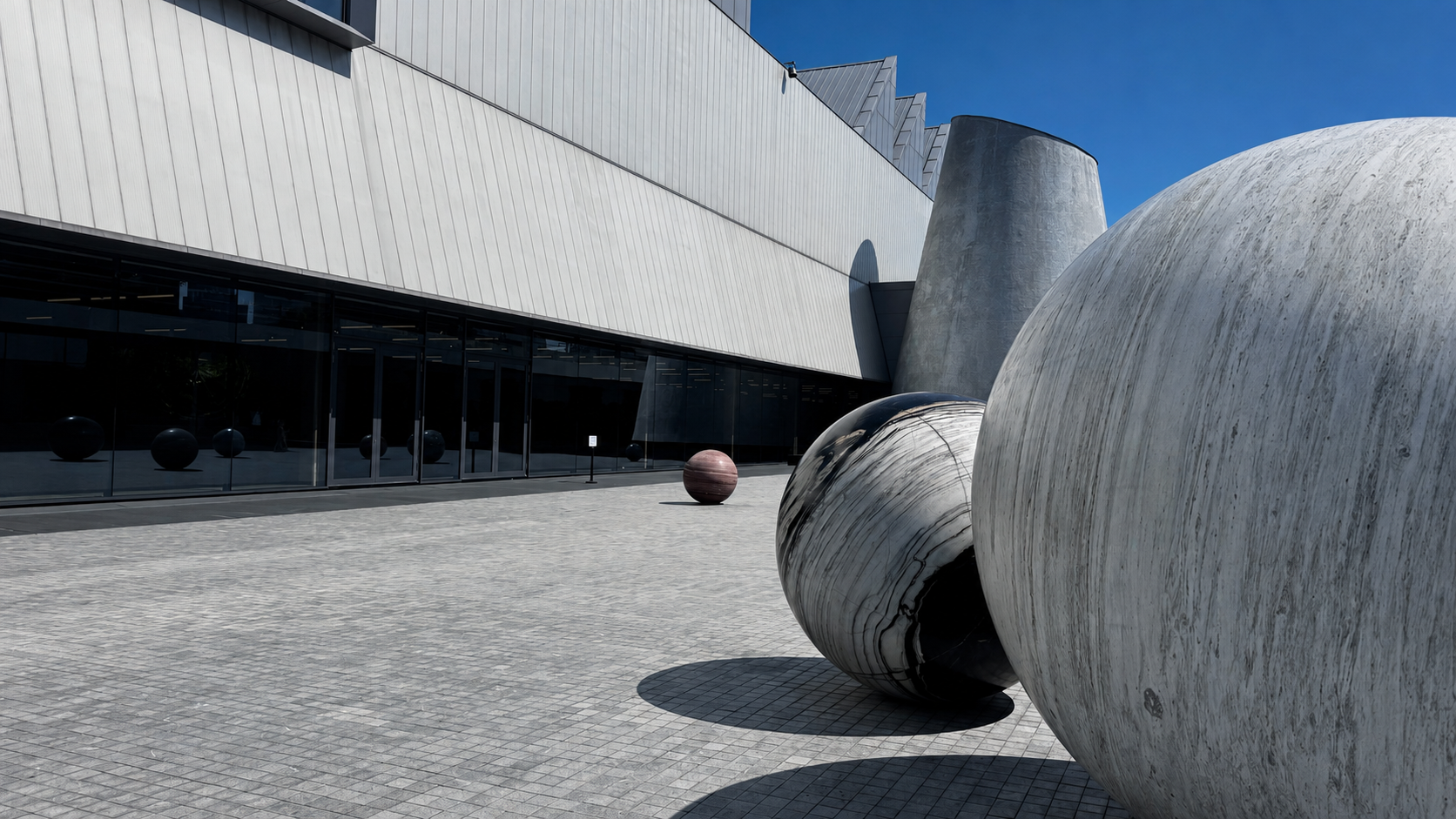
Alicja Kwade, Pars pro Toto — spherical natural stones arranged across the central courtyard of Dib Bangkok. Bangkok, Thailand, 2026. Photography · Valeria Viollaz.
Dib Bangkok became one of the most powerful experiences of my time in Thailand.
I did not enter with the intention of explaining the exhibition, nor do I write about it as an art historian. I write from what stayed with me: the physical sensations, the unexpected gestures, and the way certain works changed the pace of my body as I moved through the museum.
Before entering the galleries, the courtyard had already established its own language. Alicja Kwade’s Pars pro Toto placed enormous spheres of natural stone across the open space like planets temporarily held at ground level. Their scale was monumental, yet their placement felt precise and almost weightless.
Against the industrial architecture, the effect was strikingly brutalist: stone, concrete, glass, hard sunlight and deep shadow. The spheres appeared ancient and futuristic at once. I found myself walking around them, looking at the veining, the differences in colour and the distance between one form and another.
They did not seem to decorate the architecture. They changed its gravity.
Dib Bangkok occupies a repurposed 1980s industrial warehouse redesigned by Kulapat Yantrasast of WHY Architecture in collaboration with Architects 49. Much of the original structure has been preserved, while the museum unfolds from denser, concrete spaces toward quieter galleries illuminated by natural light. The architecture does not compete with the works. It creates the conditions in which they can be encountered.
That restraint became essential to everything that followed.
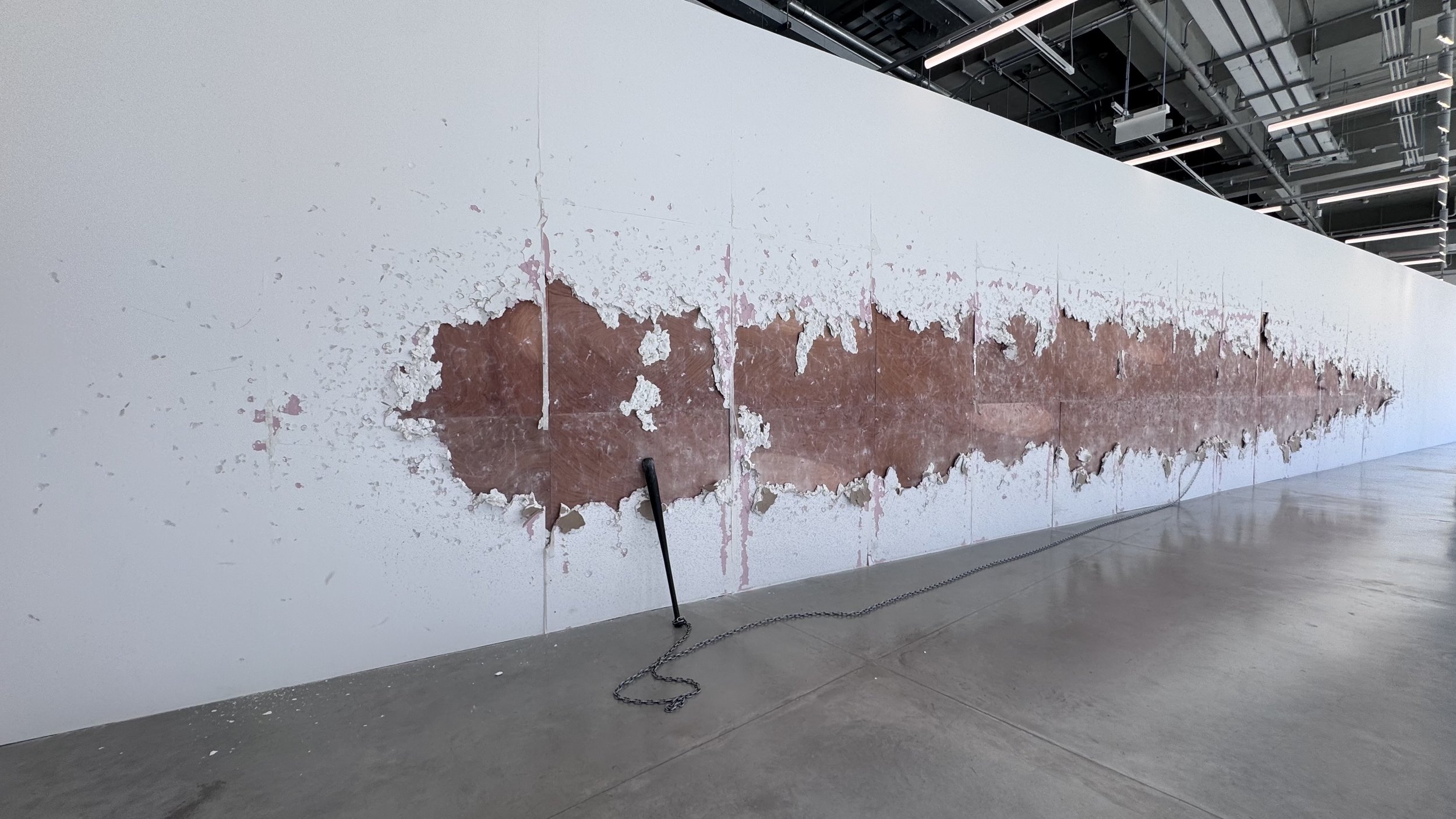
Marco Fusinato, Constellations: Bangkok, 2025 — a participatory installation transformed by the accumulated strikes of its visitors. Dib Bangkok, Thailand, 2026. Photography · Valeria Viollaz.
Later in the exhibition, I encountered a work that asked something completely different of me.
Marco Fusinato’s Constellations: Bangkok consists of a purpose-built white wall and a black baseball bat attached to a chain. Each visitor is invited to deliver one strike. Hidden inside the wall, microphones and a powerful sound system amplify the impact to approximately 120 decibels.
By the time I arrived, the pristine white surface had already been broken open by previous visitors. A long horizontal wound revealed the reddish structure beneath. The wall had become a record of accumulated gestures: different strengths, different positions, different bodies, each permitted one moment of irreversible action.
I lifted the bat and added my own strike.
The sound was not simply loud. It travelled through the room and through the body. For an instant, looking was no longer enough; the work required decision, movement and consequence. My gesture became part of its changing surface, indistinguishable from the marks left by everyone who had stood there before me.
What affected me most was the contrast. The installation was visually minimal, almost empty, yet one action released something enormous. Silence became impact. Restraint became force. The protected surface of the museum became something the visitor was explicitly permitted to damage.
I did not stand outside the work. For one brief moment, I was responsible for what happened to it.
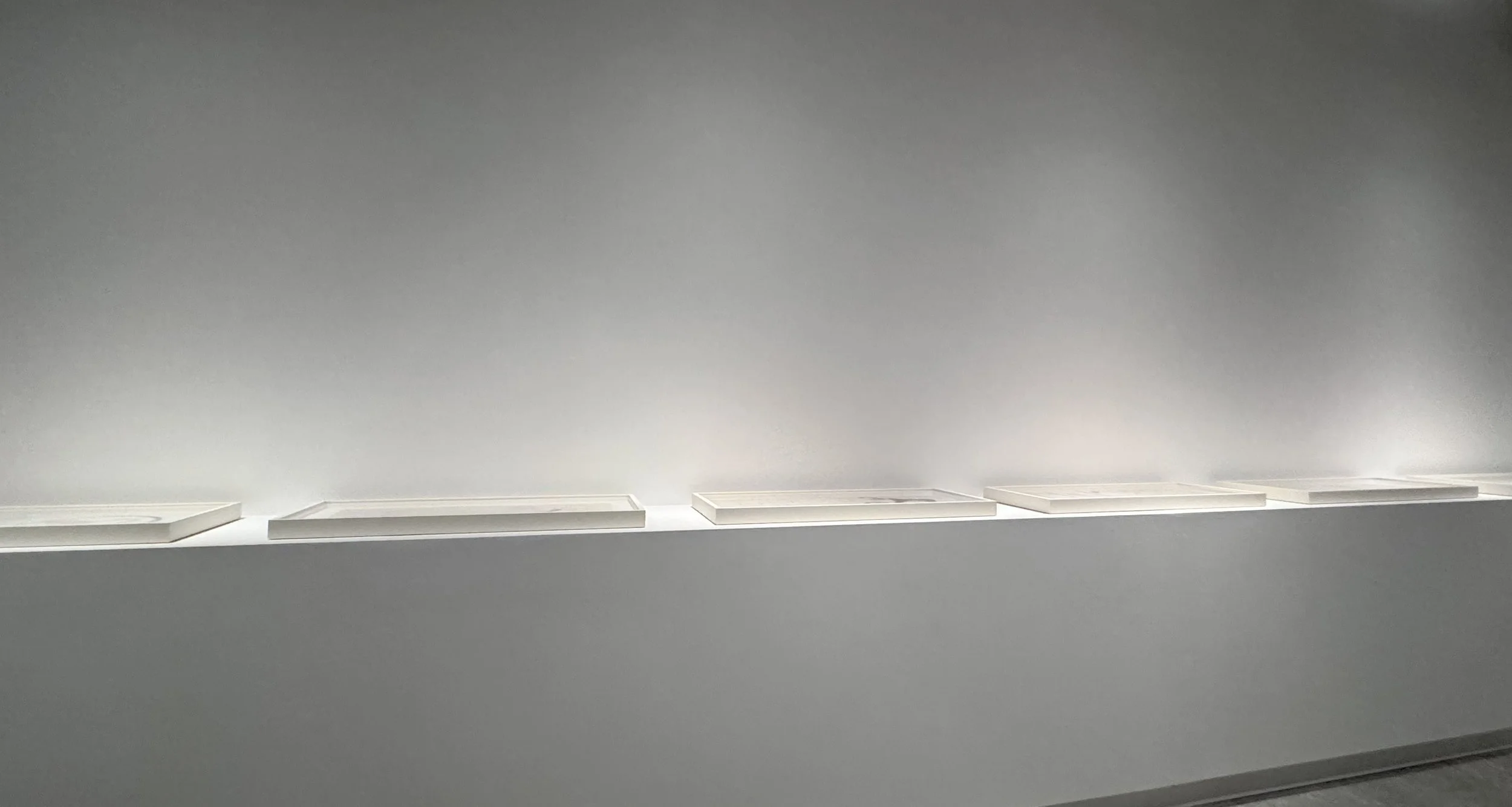
Louise Bourgeois, Nothing to Remember, 2004–2006 — twenty-two folios displayed horizontally along an illuminated plinth. Dib Bangkok, Thailand, 2026. Photography · Valeria Viollaz.
After the force of the strike came something quieter.
Louise Bourgeois’s Nothing to Remember was not hanging on the wall. Its twenty-two folios were arranged horizontally along a low, illuminated plinth. To experience them, I had to walk beside them, slow down and lean closer.
Created between 2004 and 2006, the series combines etching, drawing, handwritten words and mixed media, in part over sheets resembling musical manuscript paper. Lines intended to hold notes instead carry fragments, forms and thoughts. The pages unfold like an intimate sequence whose meaning cannot be absorbed from a single position.
Their horizontal presentation changed the relationship between the work and my body. I was not standing before a picture. I was accompanying a succession of pages. The installation felt closer to an open archive, a private score or a diary that had been carefully placed within reach but remained impossible to fully possess.
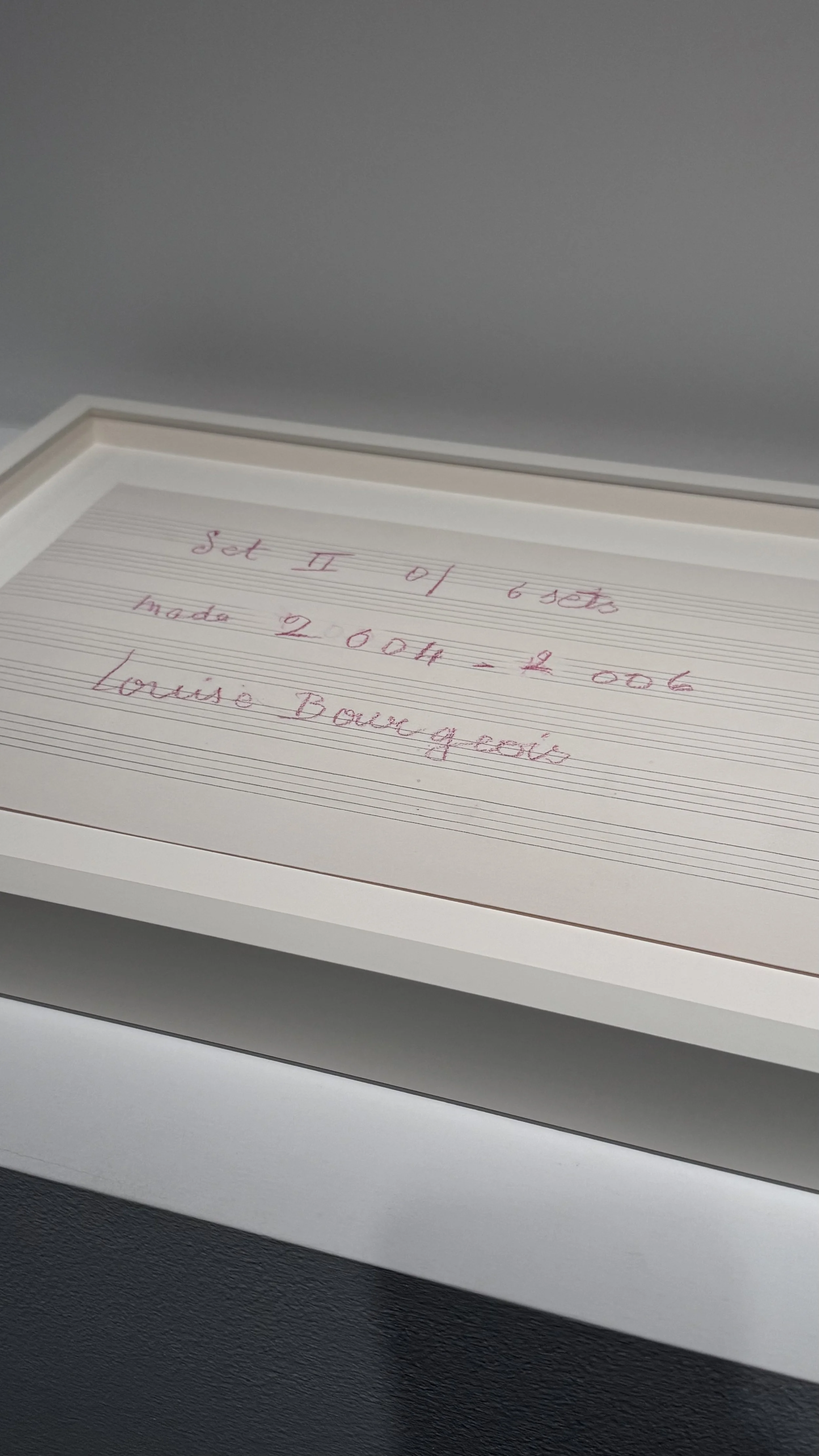
Detail from Louise Bourgeois, Nothing to Remember, 2004–2006. Handwritten text and markings on music manuscript paper. Dib Bangkok, Thailand, 2026. Photography · Valeria Viollaz.
The title, Nothing to Remember, carries its own contradiction. The work is filled with traces of someone attempting to hold, order and release what has been lived. It speaks about memory without making memory stable.
This was what moved me most: not only what the pages contained, but how they were presented. Nothing had been elevated above the visitor. The works remained low, quiet and vulnerable. Their authority came through intimacy rather than scale.
Looking back, the three encounters altered my movement in completely different ways.
Alicja Kwade made me circle stone.
Marco Fusinato asked me to strike.
Louise Bourgeois made me bend closer.
That progression — from monumental scale to physical impact and finally to intimacy — shaped my experience of Dib Bangkok. I left without needing to understand or explain every work. What remained was more direct: the weight of stone, the shock of sound, the fragility of paper and the awareness of my own body moving between them.
The strongest exhibitions do not only give us something to see. They change the way we stand, move, listen and remember.
— Valeria Viollaz
PROJECT CREDITS
Dib Bangkok
111 Soi Sukhumvit 40, Phra Khanong
Khlong Toei, Bangkok, Thailand
Exhibition visited: (In)visible Presence
Architecture: Kulapat Yantrasast · WHY Architecture, in collaboration with Architects 49
Curation and photography: Valeria Viollaz · VV Interior Home