These are antique pieces and are sold as such. Although VV does its best to highlight major flaws, minor imperfections should be expected reflecting the age and previous use of the piece.
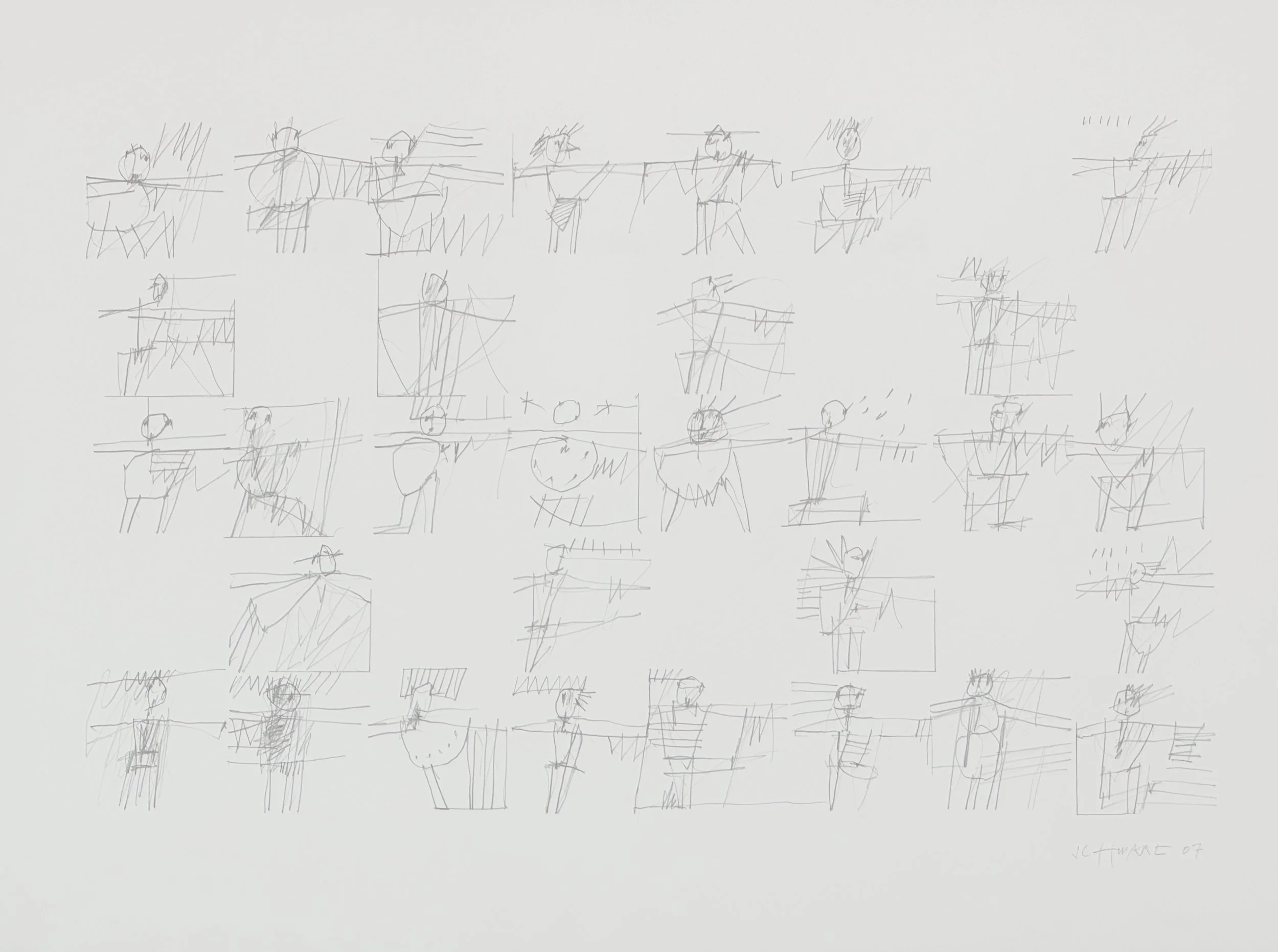
This large-format drawing by Swiss artist Emil Schwarz (1944–2012) presents an expansive figurative composition in which the human form is systematically multiplied, fragmented, and redistributed across the surface — creating a work that is at once intimate in gesture and monumental in scale.
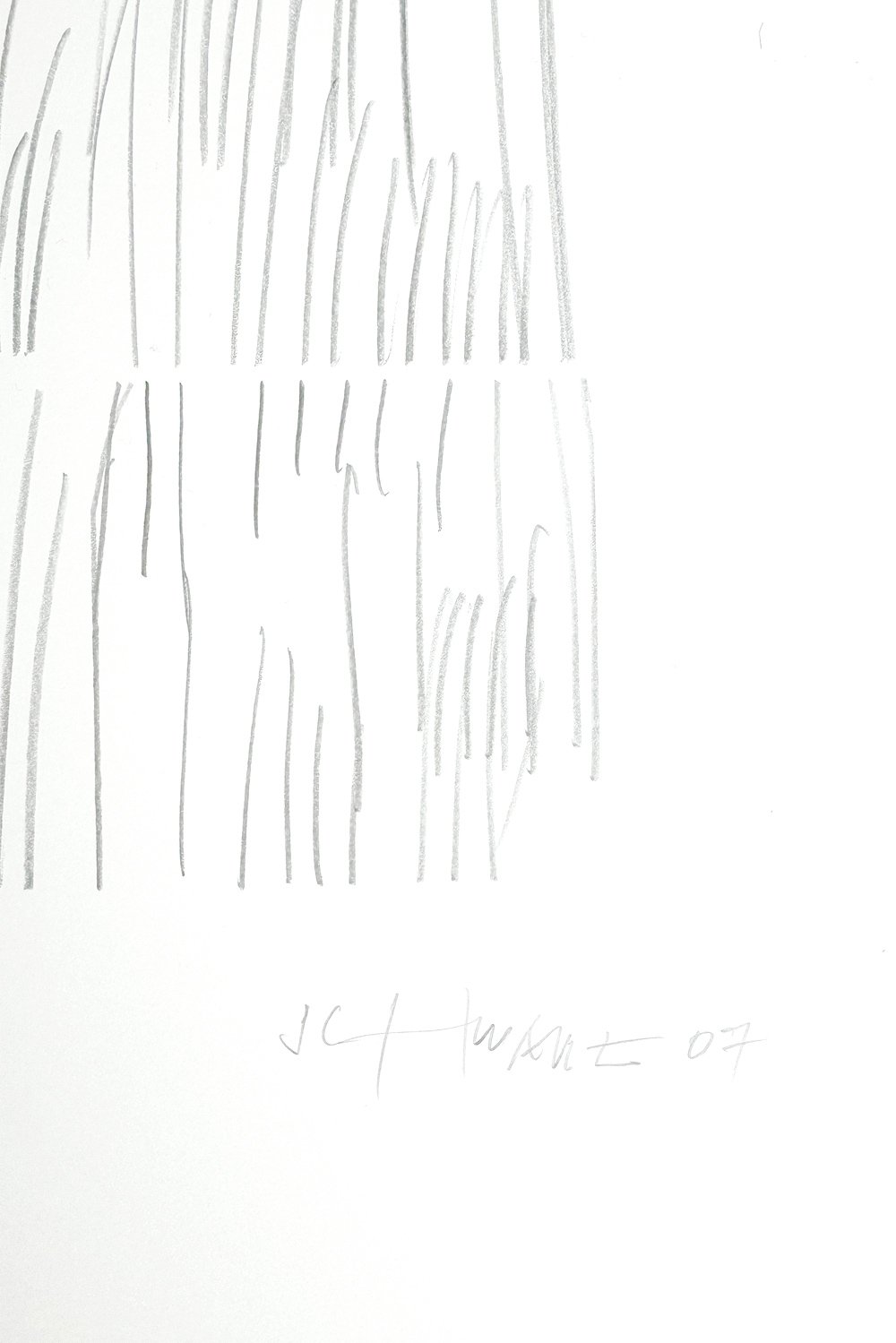
Executed in pencil on paper, the drawing unfolds as a grid of loosely defined vignettes, each containing a schematic human figure positioned within a horizontal register of lines. Rather than resolving into a singular image, the composition operates through accumulation and variation — the figure repeated, reinterpreted, and destabilized across a matrix of cells that impose order while simultaneously undermining it.
The line is rapid and spontaneous, yet deliberately placed. Schwarz employs hatching, cross-hatching, and open contour to suggest form without defining it, allowing each vignette to function both as an individual study and as an element within a larger visual rhythm. The result is a work that balances structure and improvisation, system and intuition.
Rooted in the European tradition of figurative drawing, Schwarz's practice reflects a sustained engagement with the human body as a primary subject — reduced to its most essential marks, yet unmistakably present. The grid format introduces an almost conceptual logic, recalling film storyboards, notation systems, and serial art — while remaining grounded in the immediacy of hand and pencil.
A significant large-format work from 2007, demonstrating the full range of Schwarz's graphic intelligence and his capacity to generate sustained visual complexity through the simplest of means.
Measurements: 70 × 100 cm
About the Artist Emil Schwarz (1944–2012) was a Swiss artist whose practice centered on drawing as a primary and autonomous medium. Working primarily in pencil and ink, Schwarz developed a figurative language characterized by economy of line, repetition, and compositional rigor. His works are held in private collections and are recognized for their graphic precision and sustained engagement with the human figure as both subject and formal problem.
This large-format drawing by Swiss artist Emil Schwarz (1944–2012) presents an expansive figurative composition in which the human form is systematically multiplied, fragmented, and redistributed across the surface — creating a work that is at once intimate in gesture and monumental in scale.
Executed in pencil on paper, the drawing unfolds as a grid of loosely defined vignettes, each containing a schematic human figure positioned within a horizontal register of lines. Rather than resolving into a singular image, the composition operates through accumulation and variation — the figure repeated, reinterpreted, and destabilized across a matrix of cells that impose order while simultaneously undermining it.
The line is rapid and spontaneous, yet deliberately placed. Schwarz employs hatching, cross-hatching, and open contour to suggest form without defining it, allowing each vignette to function both as an individual study and as an element within a larger visual rhythm. The result is a work that balances structure and improvisation, system and intuition.
Rooted in the European tradition of figurative drawing, Schwarz's practice reflects a sustained engagement with the human body as a primary subject — reduced to its most essential marks, yet unmistakably present. The grid format introduces an almost conceptual logic, recalling film storyboards, notation systems, and serial art — while remaining grounded in the immediacy of hand and pencil.
A significant large-format work from 2007, demonstrating the full range of Schwarz's graphic intelligence and his capacity to generate sustained visual complexity through the simplest of means.
Measurements: 70 × 100 cm
About the Artist Emil Schwarz (1944–2012) was a Swiss artist whose practice centered on drawing as a primary and autonomous medium. Working primarily in pencil and ink, Schwarz developed a figurative language characterized by economy of line, repetition, and compositional rigor. His works are held in private collections and are recognized for their graphic precision and sustained engagement with the human figure as both subject and formal problem.
These are antique pieces and are sold as such. Although VV does its best to highlight major flaws, minor imperfections should be expected reflecting the age and previous use of the piece.