
On What a Table Carries — Il Colonnato · Mario Bellini · Cassina · 1977
By Valeria Viollaz · VV Interior Home · Lucerne, Switzerland
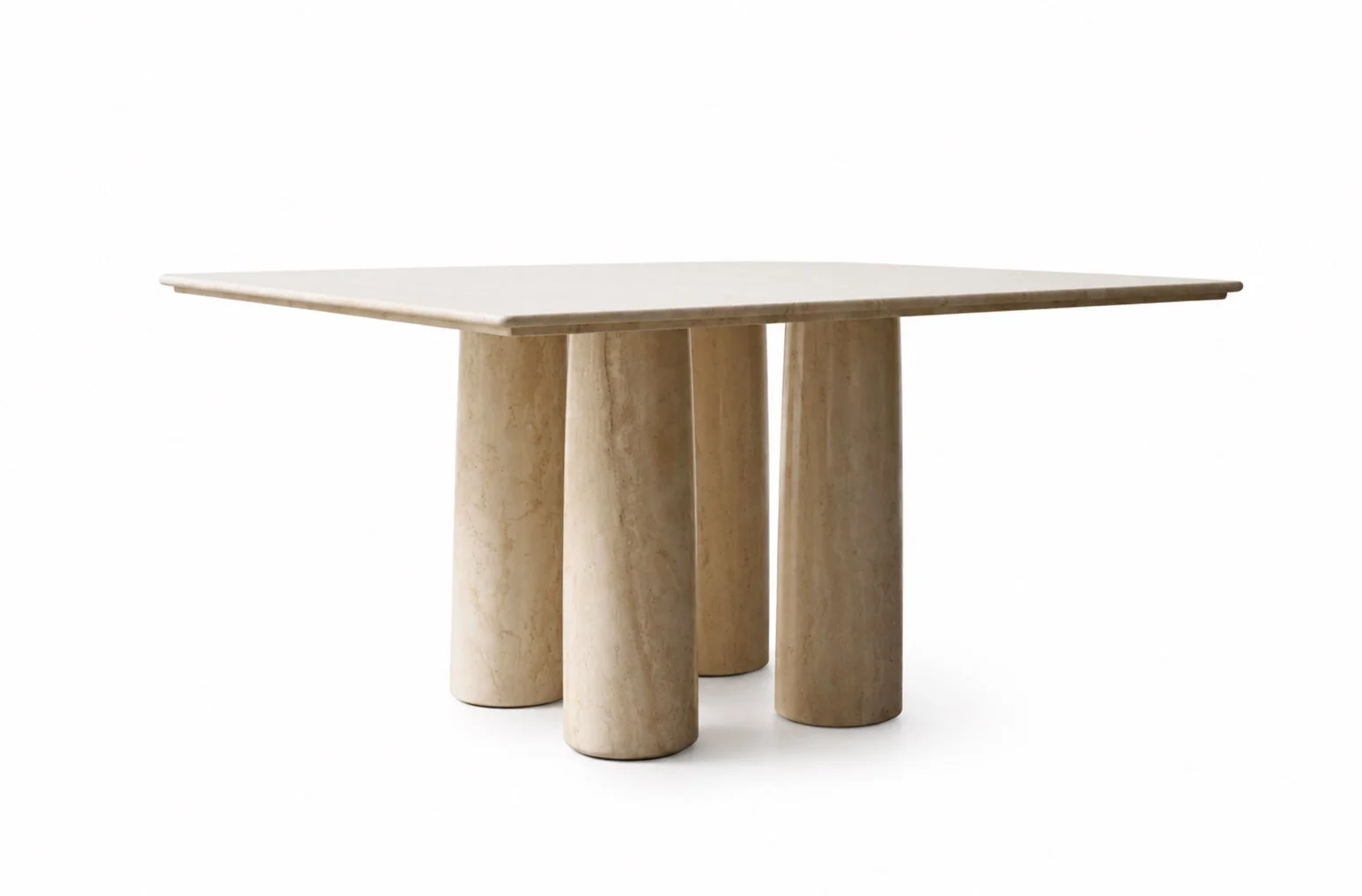
Mario Bellini · Il Colonnato · Cassina · 1977 · Solid travertine · 140 × 140 cm · VV Interior Home collection
On recognition.
There are objects you choose. And there are objects that make the choice for you.
Not because they are more practical. Not because they are more comfortable or more convenient than anything else you might have considered. But because the moment you encounter them, something settles — a recognition that does not ask for justification. That is how it works with the objects that matter. They do not need to be explained. They need to be understood.
The Colonnato arrived that way.
On the object.
Mario Bellini designed Il Colonnato for Cassina in 1977. He was an architect before he was a furniture designer — and it shows. Every decision in this piece is structural, not decorative. The four cylindrical columns are not legs. They are columns — the oldest structural invention in the history of Western architecture, reread in the language of postwar Italian modernism.
The square format is deliberate. Where a rectangular table imposes a hierarchy — heads of table, sides, a direction — the square creates equality. Every seat is equidistant from the centre. Every perspective on the table is balanced. It is a piece that gathers without presiding.
And the material. Travertine, not marble. The choice matters. Marble is formed under pressure, compressed, dense, uniform. Travertine is formed by water — by mineral-rich springs that deposit calcium carbonate layer by layer over thousands of years. The result is a stone that is porous, stratified, alive with variation. No two surfaces are the same. No two moments of light read it the same way.
Bellini understood that. He did not choose travertine for its beauty. He chose it for its honesty.
On what the stone carries.
Look closely at the edge of a travertine surface and you will see what the material is made of — layers, cavities, variations in tone and density that record the conditions of its formation. The stone does not hide this. It presents it.
That is the quality that makes travertine extraordinary in the context of design. It does not age. It accumulates. Every scratch, every variation of light, every year of use adds to what the stone already carries — it does not diminish it.
A travertine table is not an object you replace when it shows signs of life. It is an object that becomes more itself the longer it is lived with. That is a rare quality. In objects, as in people.
The Colonnato in this square format — 140 × 140 cm, four columns, a 3 cm top — carries fifty years of that accumulation. It was designed at one of the defining moments of his thinking. It was made by Cassina when Italian manufacturing was at the height of its craft. And it has arrived here, in this moment, still entirely itself.
On choosing this piece, now.
— image: full table in space —
We live in a moment of extraordinary production and extraordinary disposability. Objects arrive and disappear. Trends accelerate and dissolve. The market for design is flooded with pieces that speak loudly for a season and say nothing the next.
Choosing a piece like the Colonnato in this context is not nostalgia. It is a position.
It is the decision that some things were made once, correctly, and do not need to be remade. That the most sophisticated response to a world that produces too much is to choose the one thing that was done right and live with it for the rest of your life.
That is the philosophy behind every piece we bring into the VV Interior Home collection. Not age for its own sake. Not rarity for its own sake. Conviction. The certainty that this object carries something that nothing produced today carries in the same way.
On what happens to a space.
— image: columns detail from below —
A space is not the same after a piece like this enters it. That is not a metaphor. It is a material fact.
The Colonnato changes the proportions of a room. It changes the way light falls. It changes the way everything else in the space is read — because suddenly there is a reference point that has weight, history and absolute formal clarity.
That is what the greatest objects do. They do not decorate a room. They complete it. Or they reveal what was missing.
This is the one.
— Valeria Viollaz
Curation & Text · Valeria Viollaz · VV Interior Home · Lucerne, Switzerland · vvinteriorhome.com
Photography · VV Interior Home
Object · Mario Bellini · Il Colonnato · Cassina · 1977 · VV Interior Home collection