
To Look From Within · Sammlung Rosengart
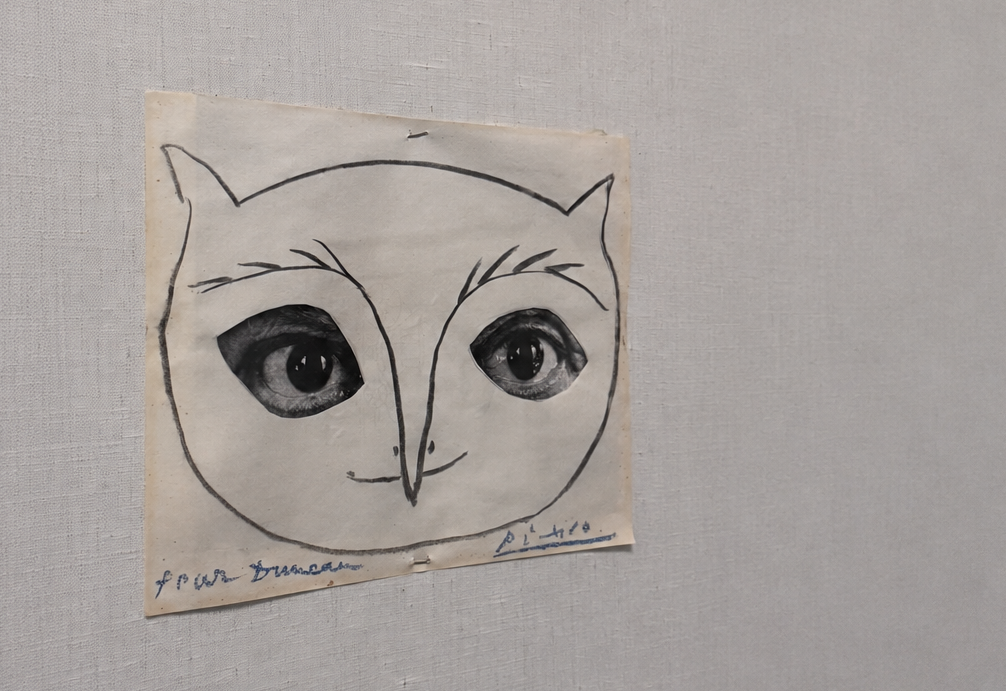
Pablo Picasso, self-portrait drawing incorporating his own photographed eyes, dedicated "pour Duncan," 1957. Museum Sammlung Rosengart, Lucerne, Switzerland, 2026. Photography · Valeria Viollaz.
Before anything else in this museum, there is a gaze.
It belongs to a small drawing — an owl’s face, outlined in a few strokes, ears raised, brows sketched like feathers. But where the eyes should have been drawn, Picasso did not draw. He cut. Two reproductions of the same photograph of his own eyes, taken by David Douglas Duncan and trimmed to the shape of the sockets, are set beneath the paper — his real gaze looking out from inside a creature that exists nowhere except on this page.
I keep returning to that decision, because it says something about how to look at everything else Picasso ever made. Across seven decades and every medium he touched — canvas, ceramic, paper, bronze — the constant was never a style. It was a way of looking: direct, unsentimental, endlessly reconstructing the same question of what a face is, what an eye does, what remains true when everything else about the image is invention.
Here, that question is asked as literally as it can be asked. The owl is entirely imagined. The eyes are entirely real. Between the two sits the whole of what Picasso spent his life doing — not looking at the world so much as finding new bodies to look from.
The work is inscribed “Picasso Pour Duncan” — for David Douglas Duncan, the American photographer who spent years inside Picasso’s homes and was allowed, more than almost anyone, to photograph him simply living. It belongs to a brief, singular body of work from 1957, created in Cannes, in which Picasso fused drawing with photographic collage — a technique he rarely repeated and one that inverts the usual logic of portraiture. Here, the invented creature is real only where the eyes are.
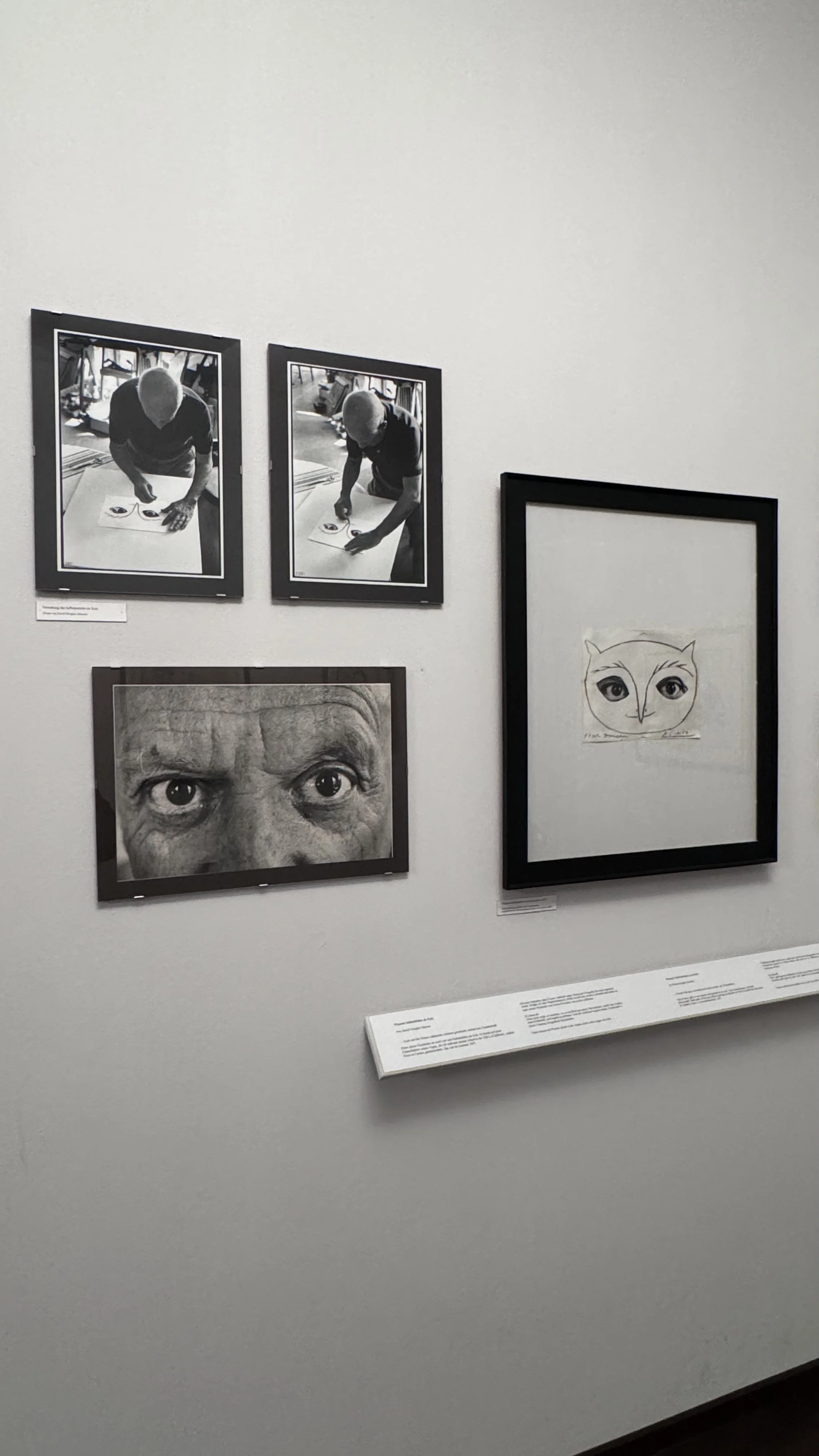
Duncan's photographs of Picasso making the owl drawing, alongside the finished piece and a portrait of Picasso's eyes, in the room dedicated to their friendship. Museum Sammlung Rosengart, Lucerne, Switzerland, 2026. Photography · Valeria Viollaz.
The museum keeps an entire room for Duncan — the only photographer given that kind of space here, among painters and sculptors. Two of his photographs, taken that same afternoon in 1957, show Picasso bent over the paper, cutting and placing his own eyes with the same concentration he brought to a canvas. Beside them hangs the finished drawing. And beside that, a third photograph — Duncan's own portrait of Picasso's eyes alone, unframed by any invented creature, looking straight into the camera.
Seeing all three together is, in its own way, a curatorial argument. It insists that the drawing not be read only as a finished piece, but as a recorded gesture — proof of exactly how one artist gave something to another, and of what those eyes looked like before they were ever set inside an owl. The photograph closes a loop the drawing only opens: here are the real eyes, unaltered, the same ones that would later be found staring out from Picasso’s invented creature.
I stood in that room longer than I meant to. It is rare for a museum to let you see a joke and its evidence in the same glance — the wit of the drawing, and the plain, unguarded photograph that proves it wasn't only a joke.
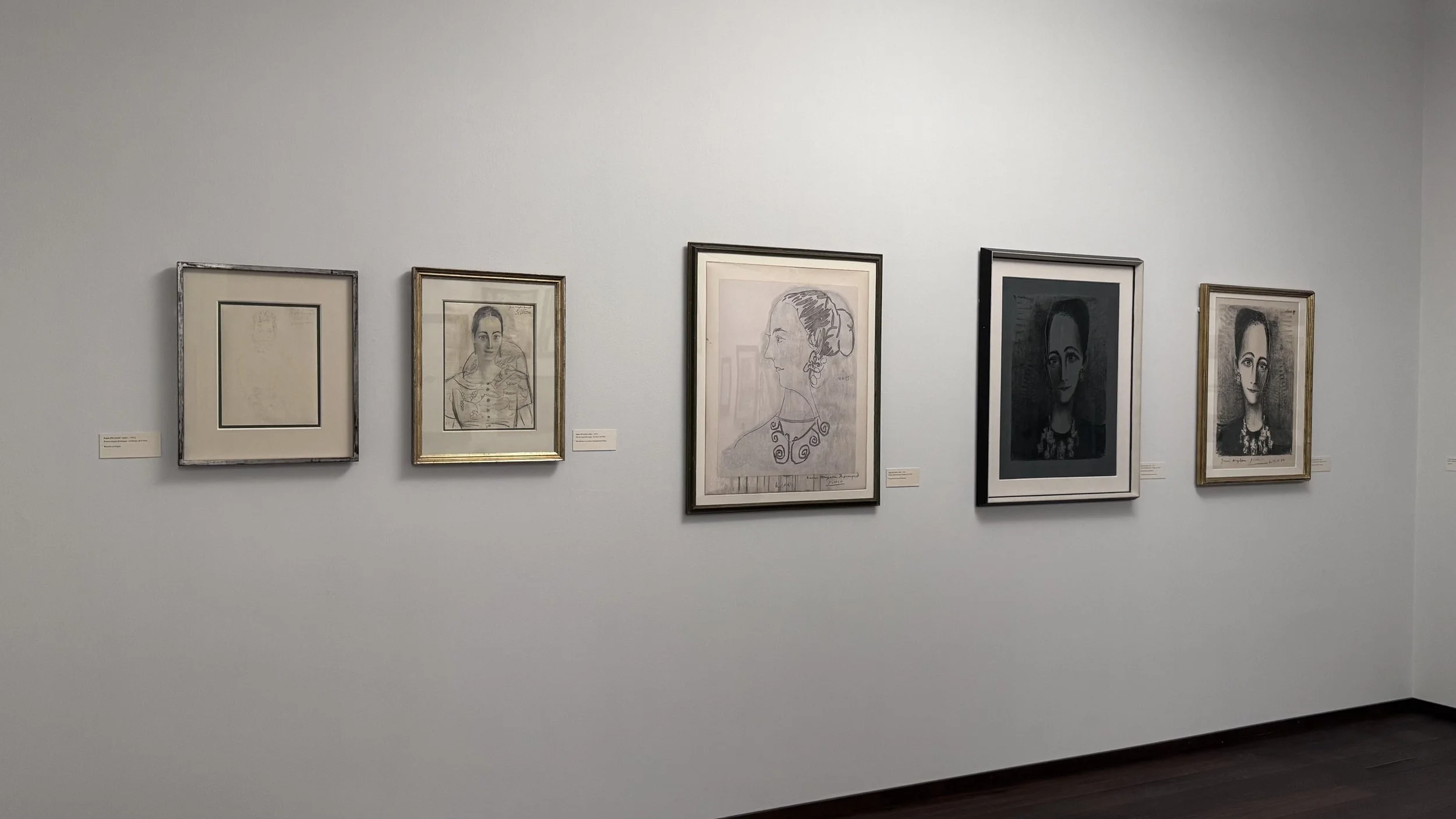
Pablo Picasso’s five portraits of Angela Rosengart, created between 1954 and 1966, displayed together at Museum Sammlung Rosengart. Lucerne, Switzerland, 2026. Photography · Valeria Viollaz.
I carried that same question up the stairs, into the room where Picasso’s gaze turns, for once, entirely outward — toward another face, portrayed not once but five times.
Angela Rosengart was twenty-two when Picasso first portrayed her, in 1954. He returned to her face four more times — in 1958, 1963, 1964 and 1966 — and each portrait reveals a different Picasso as much as it does the same sitter. The line simplifies, then hardens; the planes flatten toward the more frontal, mask-like treatment of his later work. Five portraits, twelve years, one face used as a fixed point against which to measure his own change.
That repetition is rare in Picasso’s portraiture. His best-known studies of friends — Kahnweiler, Sabartés — tend to cluster within a single year or two. Rosengart, by contrast, seems to have functioned as something closer to a constant: someone he could return to across a decade, not to capture her again, but to see, each time, how far his own eye had moved.
She was not simply his subject. She was his friend, later his gallerist, and eventually the person who gave Lucerne this museum — built inside a former bank on Pilatusstrasse — to hold what she and her father, Siegfried Rosengart, had spent a lifetime collecting.
I visited the day after she died. I had not planned it that way. Standing before five versions of her own face, made across twelve years, in the rooms she built to hold them, I understood the collection differently: not only as an archive of artworks, but as a portrait of a friendship, told five times in the hand of a man who rarely looked at anyone that many times unless something in them kept demanding to be looked at again.
I left thinking about the owl again — the eyes that were real inside a creature that was not. Five portraits, one drawing, one photograph of the eyes themselves. Different rooms, the same gaze — and the woman who kept them all together so they could continue to be seen.
— Valeria Viollaz
PROJECT CREDITS
Museum Sammlung Rosengart
Pilatusstrasse 10, 6003 Lucerne, Switzerland
Founded by Angela Rosengart (1932–2026) and Siegfried Rosengart
Housed in the former Swiss National Bank building, converted by architect Roger Diener, opened 2002
Photography · Valeria Viollaz