
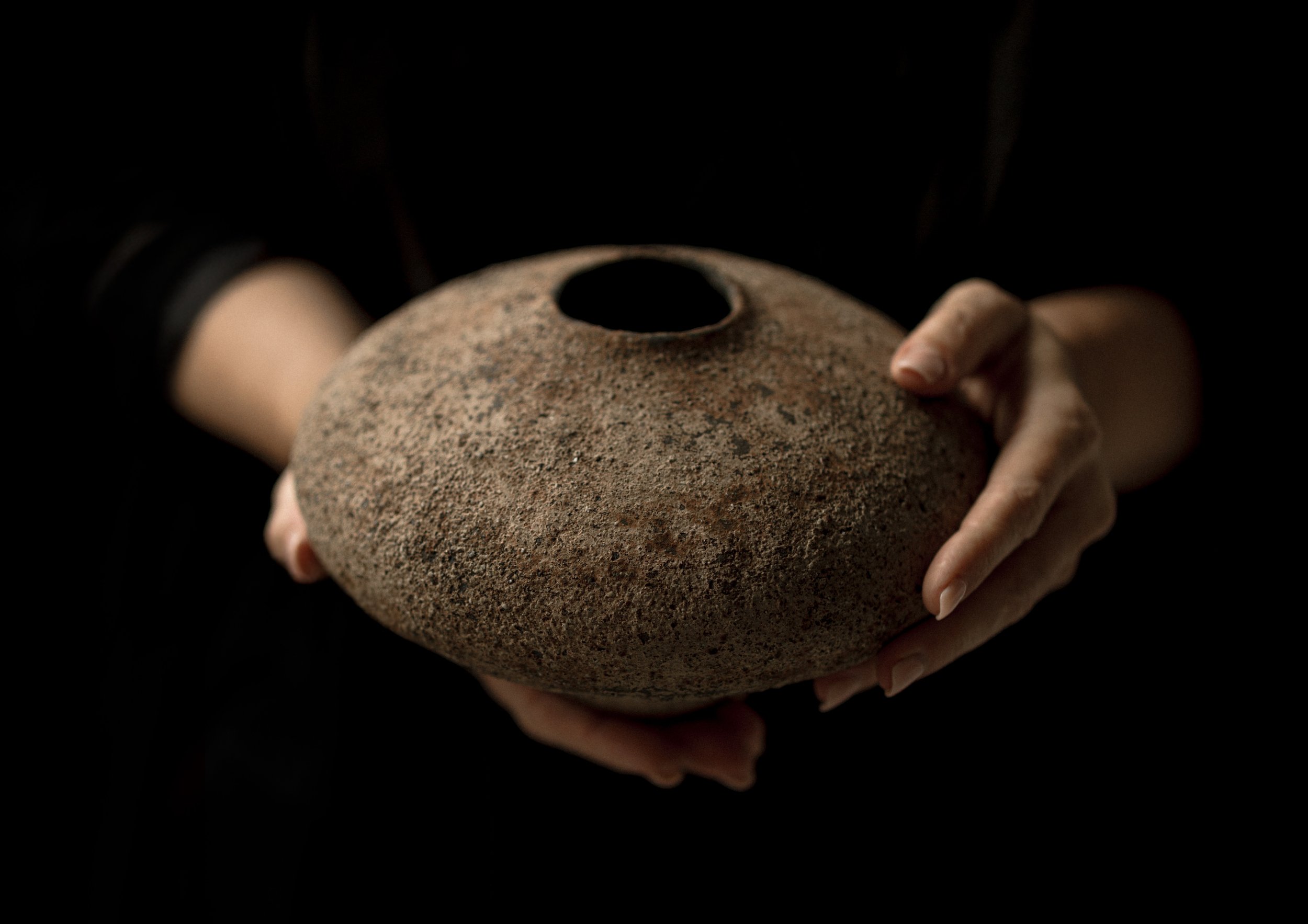
What passes through fire, and what remains. Ceramic work by Hiroshi Aoki. Photography · Rabea Hüppi.
On what remains when everything superfluous falls away.
In its culture pages for Central Switzerland, the Luzerner Zeitung presents What Remains, the exhibition curated by Valeria Viollaz at The mep, Lucerne, bringing together artists from Switzerland, Spain and Japan.
The article reads the exhibition the way it was conceived: not as a collection of works, but as a sequence. A passage from noise to silence, and a question about the memory of materials and the time objects carry within them.
The sequence opens with Forest Reverie (2026) by Carol Moreno, a canvas of almost two and a half metres built from layer upon layer of pigment. It continues through David Bürkle's Wall Object (1995) and Urs Hanselmann's folded paper landscape from the early 1970s, then into shadow and line: the drawings of Emil Schwarz, the work of Geneva sculptor Albert Rouiller, and a handmade paper signed "Hubert", from 1979.
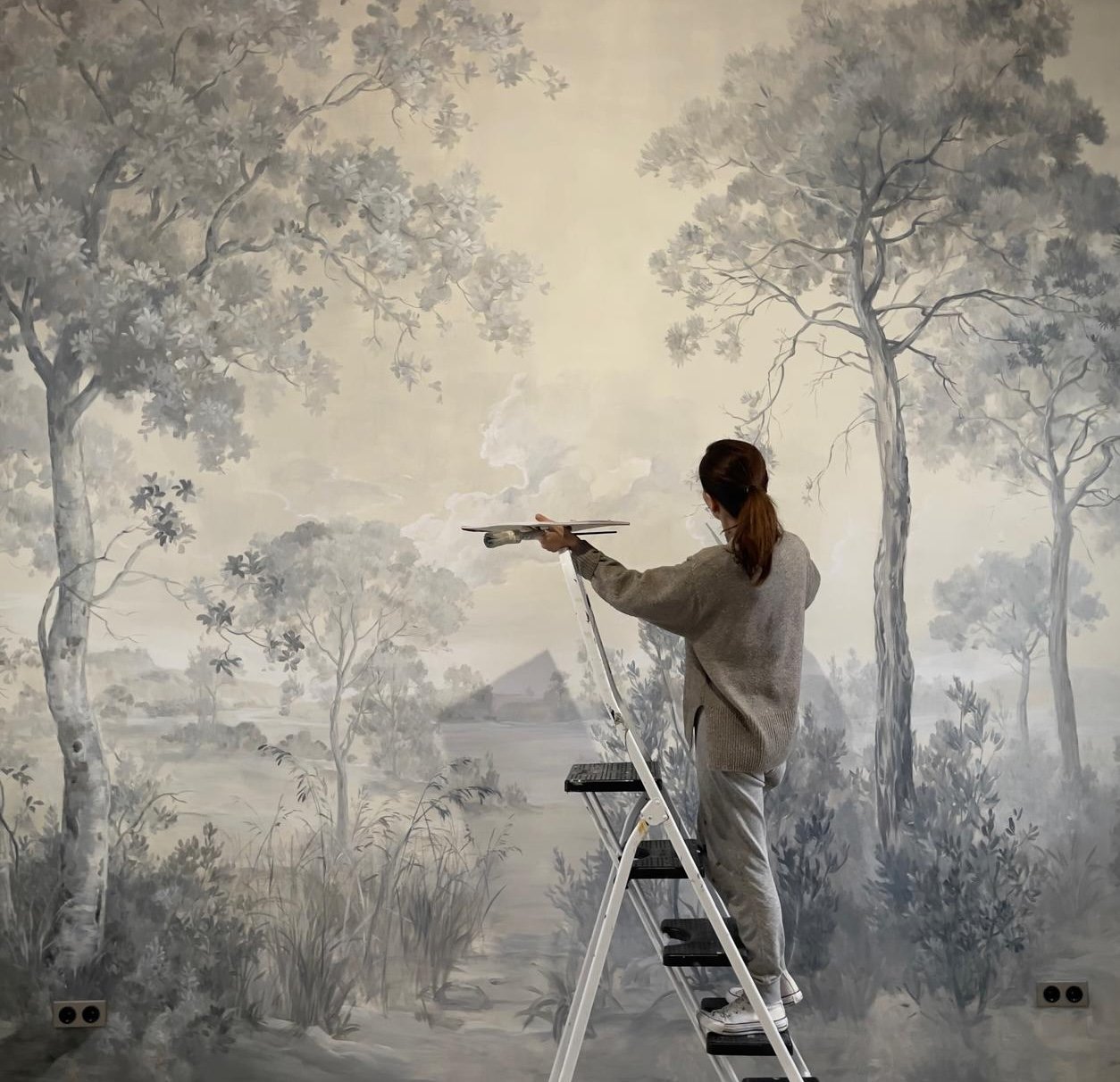
Carol Moreno at work. Her large-scale landscapes, like Forest Reverie, are built layer upon layer of pigment, by hand. Courtesy of the artist.
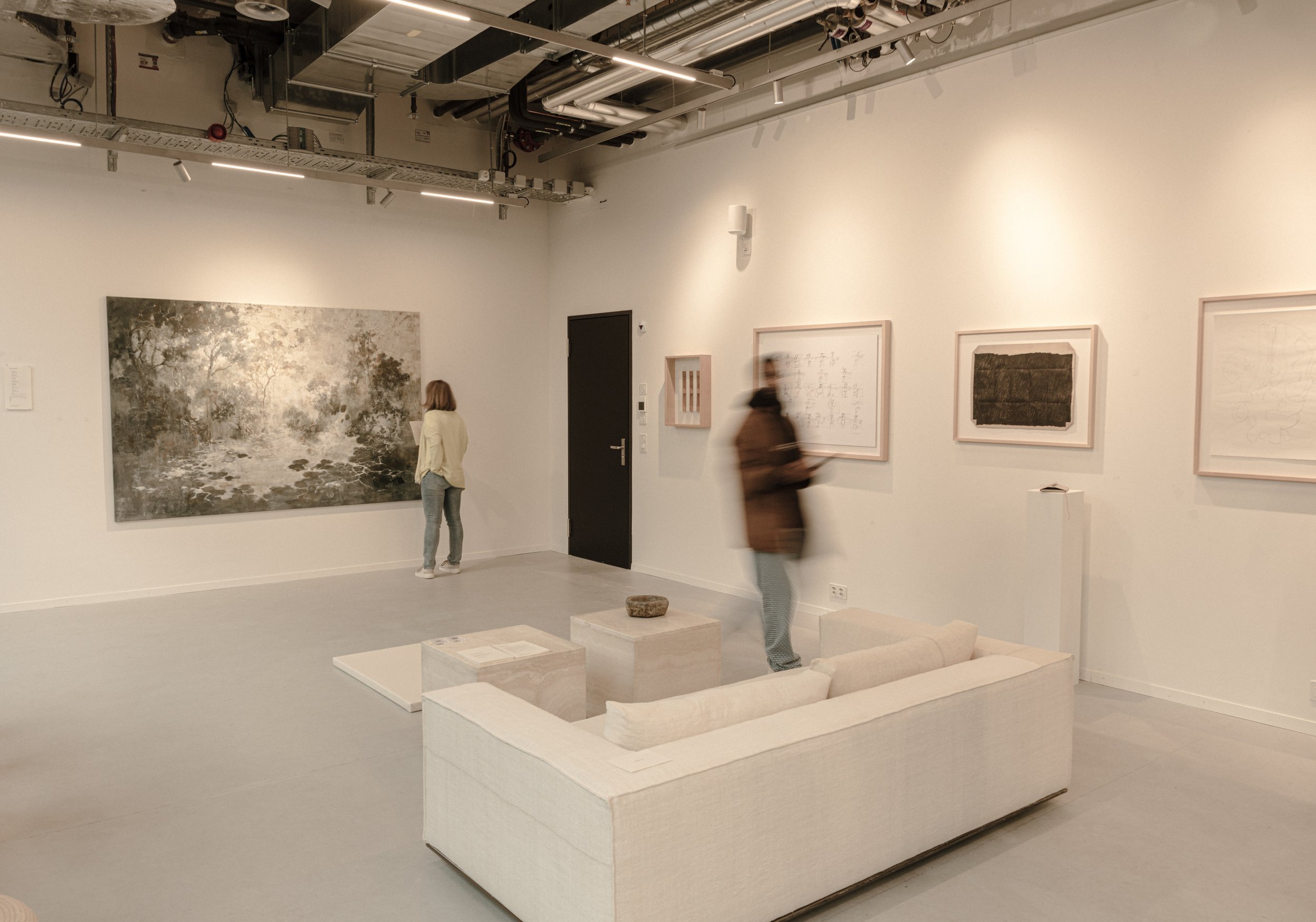
Installation view, What Remains, The mep, Lucerne, 2026. Carol Moreno, Forest Reverie, 2026, with works on paper and a vintage Minotti sofa in antique linen from the VV Interior Home collection, upholstered by Atelier Brun. Photography · Rabea Hüppi.
It ends with what outlasts the fire: three new ceramic works by Hiroshi Aoki, hand-built from several clays, glazed, fired and reworked, so that the traces of heat remain visible in the body of the clay.
In front of Forest Reverie, a vintage Minotti sofa, upholstered by Atelier Brun in antique handwoven linen from the VV Interior Home collection, invites visitors to sit and take the pause the exhibition asks for. For Valeria, the centre of the passage is clear: "Albert Rouiller's drawing is, for me, the heart."
We are grateful to the Luzerner Zeitung for following the exhibition with such attention.
Originally published in the Luzerner Zeitung, print and online, Kultur Zentralschweiz, 14 November 2026. Also published in the Bote der Urschweiz.
Original headline: «Was bleibt, wenn alles Überflüssige wegfällt?»
Read the original article →

As printed in the Luzerner Zeitung, 14 November 2026: «Was bleibt ohne das Überflüssige?» Illustrated with the ceramic work by Hiroshi Aoki. Photography · Rabea Hüppi.
PROJECT CREDITS
From Noise to Silence · As featured in the Luzerner Zeitung
Print and online · Kultur Zentralschweiz · 14 November 2026
Online headline · «Was bleibt, wenn alles Überflüssige wegfällt?»
Print headline · «Was bleibt ohne das Überflüssige?»
Also published in · Bote der Urschweiz
Exhibition · What Remains
Venue · The mep, Bürgenstrasse 6, Lucerne
Dates · 7 November – 2 December 2026
Presented by · The mep and VV Interior Home
Curation · Valeria Viollaz
Artists · Carol Moreno · David Bürkle · Urs Hanselmann · Emil Schwarz · Albert Rouiller · Hubert · Hiroshi Aoki
Upholstery · Atelier Brun
Antique linen and travertine · VV Interior Home Collection
Photography · Rabea Hüppi
Carol Moreno at work · Courtesy of the artist
Photographic Direction · Valeria Viollaz
Coordination · Viollaz Group
Perspectives · VV Interior Home · 2026
Press & Curatorial Enquiries · vvinteriorhome.com/contact